
The 2026 AI Adoption Report
Is AI really present in your day-to-day business processes? Or is it just the occasional ChatGPT query to draft an email, brainstorm an idea or crunch some numbers? Are you competing with the tech giants, or just trying to get invoices paid and keep expenses sorted?
We asked over 2,100 small business owners how they're using AI, what they plan to spend on it and how confident they feel. This report answers the questions every small business owner has before deciding their next move with AI.






AI usage
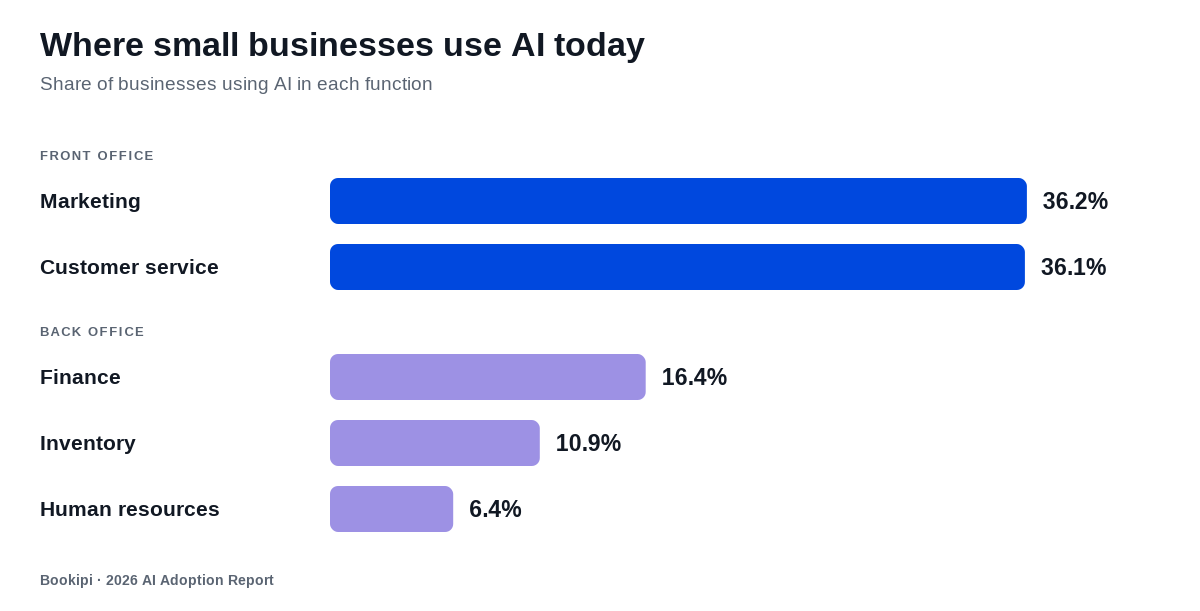
How do small businesses currently use AI?
Front-office functions are front of the line. Small businesses mostly use AI for front-office tasks such as marketing and customer service, rather than deep operational work. Marketing leads adoption at 36.2%, followed closely by customer service at 36.1%.
Far fewer use it for back-office numbers. Adoption drops sharply for finance (16.4%), inventory (10.9%) and HR (6.4%).
Missed opportunity: Back-office jobs like invoicing, bookkeeping and stock control are often repetitive, which can make them good candidates for automation. Our guide to AI challenges covers what holds small businesses back.
Barriers
What are the biggest challenges in small business AI adoption?
We asked web, tech and media, retail and transport businesses about their biggest barrier. Across the three, lack of expertise came top (31.8%), ahead of cost or unclear ROI (22.9%), integration difficulties (18.2%) and data privacy concerns (12.1%).
In retail and transport, lack of expertise was well ahead of cost (38.7% against 19.8% in retail, and 32.2% against 21.1% in transport). Web, tech and media businesses were the exception: cost or unclear ROI came top for them (29.1%).
In our view, these barriers can feed each other. Without expertise, it's hard to judge the return on AI, and without a clear return, it's hard to justify investing in AI skills and expertise.
What's blocking AI adoption
Biggest reported barrier, one answer each. Web, tech and media, retail and transport businesses (280 responses).
The answer options varied by industry. Data or privacy was offered to web, tech and media and retail businesses, and regulation to transport businesses. "Other" includes written-in answers.
The Bookipi solution: With Bookipi AI, you ask in plain language, by chat or voice, to make an invoice, show your overdue invoices or add a customer, and it does the task inside your Bookipi account.
Satisfaction
Are small businesses satisfied with the available AI tools?
We asked web, tech and media, retail and transport businesses how satisfied they are with one type of AI tool relevant to their work. Web, tech and media businesses are the happiest: 52% are satisfied with the quality of AI-generated content.
Satisfaction is much lower in retail and wholesale (32%) and transport and logistics (22%). Neutral is the most common answer in both (40% and 49%), so many of these businesses haven't made up their minds yet. Because each industry was asked about a different use of AI, read the comparison as a guide rather than like for like.
Satisfaction with AI tools, by industry
Share of businesses in each industry. Each industry was asked about a different use of AI.
- Web, tech & mediaQuality of AI-generated content (79 responses)
Satisfied 52%, neutral 34%, dissatisfied 9%, not using AI for this 5%
- Retail & wholesaleAI tools for inventory, customer experience or sales forecasting (111 responses)
Satisfied 32%, neutral 40%, dissatisfied 9%, not using AI for this 19%
- Transport & logisticsAI for routing, fleet management or scheduling (92 responses)
Satisfied 22%, neutral 49%, dissatisfied 5%, not using AI for this 24%
"Satisfied" combines very satisfied and satisfied.
Budgets
How much are small businesses going to spend on AI in 2026?
Nearly half of small businesses (48%) plan to increase their AI budgets in 2026. Only 2% plan to cut their spending, a sign that AI is here to stay.
But there's a divide. While 11.8% of businesses plan an aggressive 30–50% increase, 27% still have no dedicated AI budget at all.
AI budget plans for 2026
How small businesses expect their AI spend to change (2,121 responses)
47.7% are increasing their AI budget
Start with a plan: If you're one of the 27% with no AI budget, a simple plan for AI integration helps you choose where a small spend will make the most difference.
Industry maturity
Which industries are ahead on AI adoption?
Two numbers separate the industries pulling ahead from the ones stalling: how many owners feel confident using AI, and how many plan to spend more on it in 2026.
Web, Tech & Media and Accounting & Finance lead on confidence, at about 62% each, and most of both are increasing their AI budgets.
Consulting, manufacturing and retail businesses are investing ahead of their confidence. Manufacturing has the second-highest share planning a bigger AI budget, at 60.6%. Food & beverage is also emerging, with confidence and budgets about level.
Transport & logistics, cleaning & property maintenance, construction and trades, health care, farming and utilities sit behind. Cleaning & property maintenance has the highest share with no AI budget, at 36.4%.
| Industry | Confident using AI | Increasing AI budget | No AI budget | Stage |
|---|---|---|---|---|
| Accounting & Finance* | 62.1% | 55.2% | 20.7% | Mature |
| Web, Tech & Media | 62.0% | 63.3% | 19.0% | Mature |
| Food & Beverage | 53.7% | 50.0% | 29.4% | Emerging |
| Consulting & Professional Services | 51.9% | 58.2% | 19.0% | Emerging |
| Education | 49.0% | 41.2% | 23.5% | Mixed |
| Manufacturing | 48.5% | 60.6% | 15.2% | Emerging |
| Retail & Wholesale Trade | 45.0% | 55.9% | 21.6% | Emerging |
| Farming & Agriculture | 44.4% | 38.1% | 19.0% | Slow |
| Beauty & Wellness | 43.5% | 49.3% | 27.5% | Mixed |
| Health Care & Support Services | 43.2% | 39.5% | 25.9% | Slow |
| Utilities* | 42.9% | 42.9% | 28.6% | Slow |
| Arts, Entertainment & Recreation | 42.5% | 53.1% | 23.9% | Mixed |
| Cleaning & Property Maintenance | 41.1% | 33.3% | 36.4% | Slow |
| Building, Construction & Trade | 40.4% | 44.2% | 28.0% | Slow |
| Accommodation & Tourism* | 40.0% | 45.0% | 30.0% | Mixed |
| Transport & Logistics | 34.8% | 50.0% | 25.0% | Slow |
| Other industries | 44.1% | 48.4% | 31.0% | Mixed |
Sorted by confidence, with other industries shown last. "Confident" combines very confident and somewhat confident. "Mixed" means the industry doesn't fit one pattern. *Fewer than 50 responses, so read these figures as indicative.
Transport & logistics: The most unsure where to invest
Half of transport and logistics businesses plan to raise their AI budget, but 53% aren't sure where to put it. We asked three industries where they'll invest, and transport was the least sure. Their top areas of interest are scheduling and route planning (30% each). Only 34.8% feel confident using AI, the lowest of any industry.
Retail & wholesale: Spending, with a clearer focus
55.9% of retail and wholesale businesses plan to increase their AI budget, and 24% aren't sure where to invest. Marketing (53%) and productivity (52%) are where most plan to put their AI spend.
Adoption patterns
Which AI functions do small businesses adopt together?
Only 11.1% of small businesses use AI in three or more areas of the business. Those that branch out tend to bring their numbers together: finance, inventory and HR.
How many areas of the business use AI
"One area or none" includes about 1 in 10 respondents who said they don't use AI yet.
Which functions go together
A correlation score shows how closely two uses are linked: 0 means no link, 1 means they always go together.
- Finance and inventory0.32 moderate
- Finance and HR0.28 moderate
- Customer service and HR0.16 weak
- Marketing and customer service0.07 very weak
About half of businesses using AI for inventory or HR also use it for finance. Marketing and customer service are the two most common uses, but they show almost no link to each other.
Confidence
Are small businesses confident using AI?
44.4% of small business owners feel confident using AI tools effectively. 31.3% are neutral and 24.3% aren't confident.
Confidence by planned 2026 AI budget
Spending and confidence go together
Businesses planning a 30–50% budget increase are 2.5 times as likely to feel confident with AI as businesses with no AI budget. Even a modest 5% increase comes with 55.7% confidence.
A survey can't tell us which comes first. But businesses with no AI budget are also the least confident using it, so an easy, low-cost place to start matters most for them.
What to do next
How can small businesses get past the AI expertise barrier?
In the three industries we asked, lack of expertise was the biggest barrier, so the best first steps are the ones that need the least of it. None of these need a consultant or a data team. For a longer plan, see our guide to building an AI strategy for a small business.
Choose AI inside tools you already use
AI built into software you already run means there's nothing new to learn, migrate or maintain, so it's a smaller step than adopting a separate platform.
Start with something you can measure in 90 days
"Improve decision-making with predictive analytics" takes months to judge. "Automate invoice processing" shows up within weeks, in numbers you already track: hours saved, days to get paid, errors caught.
Consolidate instead of adding tools
Among web, tech and media, retail and transport businesses, 18.2% say AI is hard to fit with their current tools. Favour one platform that uses AI across several related jobs over a separate tool for each.
Rank tasks by time, repetition, then errors
Find the task that takes the most time, then the most repetitive one, then the one where mistakes happen most. AI works best where all three overlap, so start with one clear pain point.
Cite this report
You're welcome to use these figures in your own articles and research. Please credit the Bookipi 2026 AI Adoption Report and link to this page.
Bookipi (2026). The 2026 AI Adoption Report. https://bookipi.com/ai-adoption/
Methodology
This report is based on an online survey of 2,121 small business owners and operators across 17 industries, collected in October 2025. We asked what they use AI for, what they plan to spend on it and how confident they feel. Web, tech and media, retail and transport businesses (282 responses) also answered questions on satisfaction, where they'll invest next and their biggest barrier (280 answered that one).
Limitations. All answers are self-reported, and respondents decided for themselves what counts as AI. Building, construction and trade businesses make up 27% of the sample, while some industries are small: utilities, accounting and finance, and accommodation and tourism each have fewer than 50 responses. Read figures for those industries as indicative.
Definitions. "Satisfied" combines very satisfied and satisfied. "Confident" combines very confident and somewhat confident. Neutral, dissatisfied and not-using answers are reported separately.
 BookipiAI
Let your AI assistant do it for you
Trusted everywhere by freelancers and businesses