
How to pick a website name is a question many entrepreneurs have when they decide to take their business online. And it isn’t purely a technical decision; it’s one about branding.
After all, your domain name can be the first piece of your brand’s online story. Your clients and customers ought to know your website name and be able to remember it so they keep coming back.
But for small business owners, it feels like all the good website names are gone. Say you finally land on the perfect name for your freelance business, you go to a domain registrar, and the website name you want just happens to already be taken.
Another alternative is seeing it might be up for grabs…but it’s for sale for $25,000. This can be a frustrating process. But finding a great domain name is still possible. It just requires a data-driven process. And given that around 44% of all websites still use a .com extension, the pressure to find a good one is high.
Let’s walk through the steps for how to choose a domain name that works for you, from initial brainstorming to the final purchase.
What exactly is a domain name, and why is it so critical?
A domain name is your website’s address on the internet (like “bookipi.com”). But it’s not just an address.
For a freelancer or small business, it’s your digital identity, your first impression, and a massive signal of credibility. It’s the difference between “yourbrand.com” and “yourbrand.xyz-hosting-free.net”. One says “I’m a professional business,” and the other says…well, something else.
Think of it as digital real estate. A good domain name is like setting up your shop on Main Street.
It’s easy for people to find, easy to remember, and it tells people you’re a permanent, trustworthy fixture. A bad one is like being in an unmarked building down a back alley.
Your domain name affects:
- Memorability: How easily can a customer remember your name after hearing it once?
- Branding: Does it reflect your brand identity?
- Search: It can signal to search engines what your website is about, which can help your ranking.
How do I start brainstorming a website name?
Start with your brand, not the domain registrar. Ask yourself: what is my business name? If you’re a freelance photographer, using your own name (e.g., “seankohphoto.com”) might be perfect. If you’re building a separate business entity, you’ll want a brand name. Make a list of keywords that describe what you do, who you serve, and your unique value.
Once you have that core list, you can start building out ideas.
Make it short, simple, and memorable
This is my top rule. If you have to spell your name out loud, you’ve already lost.
- Keep it short. Aim for under 15 characters if you can. “bookipi.com” is better than “bookkeepingandinvoicingapp.com.”
- Make it easy to spell and pronounce. If a customer hears your name on a podcast, they should be able to type it correctly. Avoid unconventional spelling (like “U” instead of “you”) or words with multiple spellings (like “express” vs. “xpress”).
- Watch for word merging. Be careful when two words blend together. A classic example is “childrenswear.com” (Children’s Wear) which can look like “children swear.” Say it, type it, and have someone else read it.
What about keywords for SEO?
Including keywords in your domain can be a smart move, as it signals to search engines what your site is about. It’s the easiest way to show up on Google search and boost your traffic.
For example, if you run a local glass repair business, “PhoenixGlassRepair.com” is a fantastic, descriptive domain.
A coffee brand called Verve using “vervecoffee.com” is another great example. It includes both the brand (“Verve”) and the keyword (“coffee”).
But here’s a pro tip when it comes to using keywords when picking your website name: don’t force it.
A catchy, brandable name is almost always better than a clunky, keyword-stuffed one. “GlassRepairForCheapInPhoenix.com” can read as just bad. The keyword is a bonus, but the brand comes first.
Should I use a domain name generator?
Feeling stuck? This is where AI and generators are actually useful. You can plug in your main keywords (like “blue,” “widget,” “design”) and a domain name generator will spin out dozens of ideas.
Many tools will combine your words, add prefixes or suffixes, and, most helpfully, only show you names that are currently available. It’s a great way to break through a creative block.
What are the biggest mistakes to avoid?
The most common mistakes are using hyphens and numbers in your domain. People mistype them constantly.
When you tell someone your website, you have to say, “it’s my-brand, dash-com.” Or, “it’s the number 5, not the word ‘five’.” It’s confusing and looks dated. It also makes typing on a mobile device a pain, as you have to switch keyboards.
The only exception? If the number is part of your actual brand name. In that case, it’s consistent. Otherwise, avoid them.
The other big mistake is picking a name that’s too specific. Say you start out selling only flowers in your city, so you register a domain name like “cityflowers.com.” What happens in two years when you want to sell vases, garden tools, or expand to the next town? You’re stuck.
A more brandable name like “cityblooms.com” would have let you scale. Think about your five-year plan, not just your five-month plan.
How do I choose the right domain extension (TLD)?
The TLD is the part after the dot. The “.com” is, by far, the most established and credible extension. It’s the default. People instinctively type .com, so if you can get it, you probably should.
But what if your .com is taken? Don’t panic. There are hundreds of other TLDs that can work just as well, or even better.
When to use alternative TLDs
These new TLDs offer a great chance to get a short, relevant name. They can also immediately tell customers what you do.
- E-commerce: .shop , .store , or .biz.
- Tech/Startups: .tech , .ai , or the very popular .io.
- Creatives: .art , .design , or .me.
- Organizations: .org is the standard for non-profits.
- General: .co has become a very common and respected global alternative to .com.
What about local and country-code TLDs?
If your business is local, using a geographic TLD is a powerful signal. It builds local trust and tells search engines exactly where you are relevant. This can be a huge boost for local SEO. You could use a city TLD like “.boston” or a country-code TLD (ccTLD) like “.in” for India or “.ca” for Canada.
One quick data-driven tip: before you buy a niche TLD, do a quick search on its reputation.
Some research from Spamhaus (a spam-tracking organization) found that certain TLDs, like “.top” or “.xin,” had high levels of malicious use. This can create a trust issue with users. Sticking to more established TLDs is usually a safer bet.
What steps do I take after I pick a website name?
Once you have a name you love, you should take a couple extra steps, and this can be one of the most overlooked steps when you pick a website name.
Step 1: The Legal Check
First, check if the name is trademarked. A quick search on USPTO.gov (the US Trademark Electronic Search System) can tell you if someone has registered a similar name.
Using a trademarked name, even accidentally, could lead to a legal battle that costs you your domain and a lot of money.
Step 2: The Social Media Check
Your brand should be consistent. Go to Instagram, Facebook, TikTok, and X (Twitter) and see if your desired name is available.
Having “mybrand.com” but being forced to use @my-brand-official-1 on social media can be a bit of a pain. This helps you build a unified brand presence from day one.
Step 3: The Google Search
Just Google the name. Is another company in a different industry using it? Is it associated with something negative? Does it mean something embarrassing in another language? Do this 5-minute check before you commit.
Step 4: Check if it’s for sale
What if the .com you want is technically taken but isn’t being used? It might be for sale on a domain marketplace. These pre-owned domains can sometimes be a good investment. Some even have an existing backlink profile that can give you a small SEO head-start. But a word of warning: check the domain’s history (using a tool like the Wayback Machine) to make sure it wasn’t used for spam or anything shady in the past.
What should I know about the purchasing process?
Okay, you’ve done your research. The name is clear, the socials are available, and you’re ready. Now, act fast. Good domain names sell very quickly.
Here’s what to look for when you buy:
- Check the renewal fee. Many registrars offer a super low domain pricing for the first year ($1.99!) but then charge $22.99 every year after. Check the renewal terms. Set up auto-renewal so you don’t accidentally forget to pay and lose your domain a year from now.
- Buy the variations. This is a pro-tip for protecting your brand. If you bought “mybrand.com,” I recommend also buying common misspellings (e.g., “mybrnad.com”) and maybe the .co or .net versions. You don’t need to build sites on them. Just forward them all to your main .com site. This stops a competitor from setting up shop right next to you.
Getting your website and domain in one place
As a small business owner, you have to juggle a dozen different tools. You might buy your domain from one company, get website hosting from another, and use a great website builder from a third-party, then figure out how to get your website seen on Google and discovered by customers. It’s a lot to manage, and the costs add up.
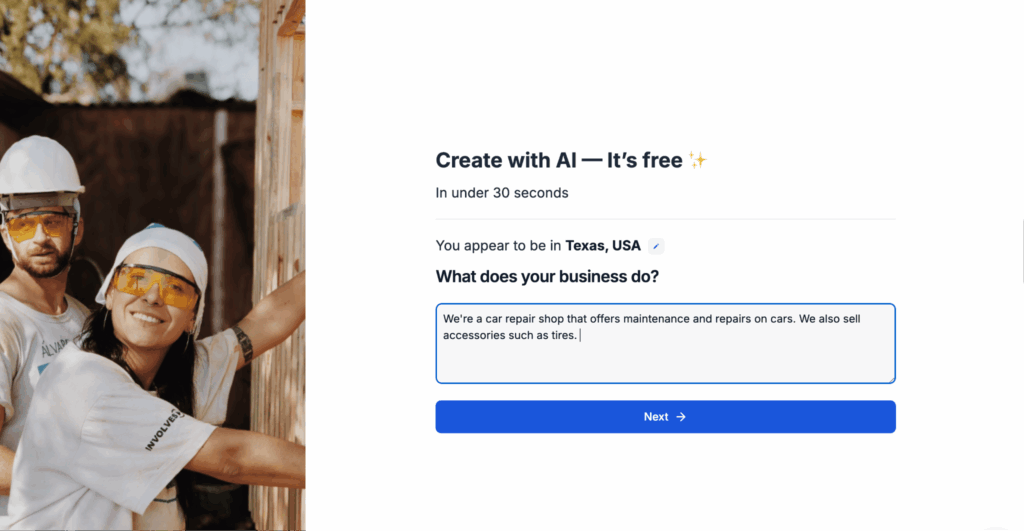
This is where an integrated platform makes a huge difference. At Bookipi, we designed our Bookipi AI Website Builder to solve this exact problem for freelancers and small businesses.
You can build a professional, mobile-friendly website in minutes. Best of all, when you’re on a paid plan, it comes with free domain hosting.
This means you don’t have to worry about buying your domain separately and figuring out how to connect it. It’s all in one place. You can manage your invoices, track your expenses, and run your professional website from a single platform that you can access on your laptop or your phone. It’s cheaper, simpler, and built for how you actually work.
So stop juggling platforms. Build your brand and manage your business in one spot. And that’s how you pick a website name that actually helps you grow.